Newborn skin changes quickly in the first weeks of life, so a cluster of tiny bumps can be surprising even when your baby seems perfectly comfortable. Newborn baby acne is common, usually harmless, and often settles without treatment. The most useful approach is not to “fight” the spots, but to recognize the typical pattern, keep the skin clean without over-washing, and know which changes deserve a clinician’s attention.
What newborn baby acne can look like
Baby acne usually appears as small red, pink, or skin-coloured bumps. Some spots may have a tiny pale centre, giving them a pimple-like appearance. On darker skin tones, redness may be less obvious, so the texture of the bumps can be easier to notice than their colour.
The cheeks and forehead are common areas, but spots may also appear on the chin, scalp, neck, upper chest, or back. Baby acne often develops during the first few weeks after birth, frequently around two to four weeks of age. It can look more noticeable when a baby is warm, crying, or when the skin has been rubbed.
A typical newborn face rash caused by baby acne does not usually make a baby ill. The skin may look busy, but the baby generally feeds, sleeps, and behaves as usual.
Baby acne or another kind of newborn spot?
Not every bump on a newborn is acne. Several normal newborn spots can look similar at first glance, and telling them apart is one reason parents may feel unsure.
Milia
Milia are tiny white or pearly bumps, often seen on the nose, cheeks, or chin. They are not pimples and should not be squeezed. They usually disappear on their own within a few weeks.
Heat or moisture-related irritation
Small bumps can also appear where a baby becomes hot or where milk, drool, or spit-up repeatedly touches the skin. These rashes may be concentrated around the mouth, chin, neck folds, or areas covered by warm clothing.
Other newborn rashes
Newborns can develop several temporary rashes that are difficult to identify from appearance alone. If the spots blister, crust, ooze, spread rapidly, look painful, or are accompanied by other symptoms, it is sensible to ask a pediatrician or other qualified health professional to examine them rather than assuming they are baby acne.
A gentle newborn skincare routine
With newborn baby acne, less is usually more. The skin barrier is still developing, so aggressive cleansing or adult acne products can create irritation without making the spots disappear faster.
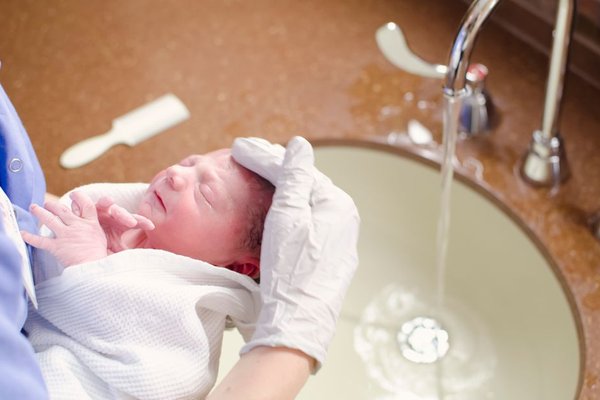
Wash your baby’s face gently once a day with lukewarm water. If you use a cleanser, choose a mild product made for babies and avoid heavily fragranced formulas. Use your clean hand or a very soft cloth, then pat the skin dry instead of rubbing it.
A practical routine can fit around feeding. For example, if milk or spit-up reaches the cheeks or chin, gently rinse or wipe the area with water and pat it dry. Later, during the baby’s regular wash, clean the face once rather than repeatedly scrubbing every visible spot. This keeps residue off the skin without turning newborn skincare into constant cleansing.
What to avoid on baby acne
It can be tempting to treat the bumps like teenage acne, but newborn skin needs a different approach.
Do not squeeze, pick, or scrub the spots. Avoid using adult acne washes, benzoyl peroxide, salicylic acid, retinoids, medicated creams, or other acne treatments unless your baby’s healthcare professional specifically recommends them. Thick oils and greasy ointments may also make some acne-like eruptions look worse.
Home remedies deserve the same caution. A product being natural does not automatically make it suitable for a newborn’s face. Essential oils, strongly scented products, and homemade mixtures can irritate delicate skin.
For related daily care, a useful internal topic is newborn skincare basics. Another natural follow-on is how to bathe a newborn safely, especially for parents who are unsure how often a young baby needs a full bath.
How long does newborn baby acne last?
Many cases improve gradually over several weeks, although some can last for a few months. The spots may look better one day and more noticeable the next. That uneven pattern does not necessarily mean the condition is getting worse.
Most uncomplicated baby acne clears without scarring. If the eruption is severe, forms deep lumps or cysts, seems to be scarring, or is not gradually improving, ask your baby’s clinician for advice. A persistent acne-like rash can sometimes need a closer look to confirm that it is truly baby acne.
When a newborn rash needs medical advice
Because many newborn rashes can resemble one another, contact a healthcare professional if you are unsure what you are seeing or if the rash is changing quickly. Seek prompt medical advice if your baby seems unwell, is feeding poorly, is unusually sleepy, has trouble breathing, develops blisters or rapidly spreading redness, or has a temperature of 38°C or higher when younger than three months.
A rash that does not fade when pressed, significant swelling, blue or grey colouring, or difficulty waking a baby requires urgent medical assessment. These are not typical features of simple newborn baby acne.
Frequently asked questions
Is newborn baby acne caused by poor hygiene?
No. Baby acne is not a sign that a baby’s face is dirty. Over-washing can irritate delicate skin, so gentle once-daily cleansing is usually a better approach than frequent scrubbing.
Can I put acne cream on my newborn’s spots?
Do not use over-the-counter acne medicines on a newborn unless a qualified healthcare professional has specifically advised you to do so. Products designed for teenagers and adults can be too harsh for newborn skin.
Should I moisturize a newborn face rash?
Not every newborn rash needs moisturizer. If the skin is dry, ask your baby’s healthcare professional or pharmacist about a simple, fragrance-free product suitable for newborns. Avoid automatically covering acne-like bumps with thick oils or ointments.
Will baby acne leave scars?
Typical newborn baby acne usually clears without scarring. Picking, squeezing, or using harsh treatments can irritate the skin, which is another reason to keep care simple and hands-off.
Gentle care is usually enough
Newborn baby acne can look dramatic on soft, otherwise clear skin, but the appearance is usually more concerning than the condition itself. Watch the overall pattern rather than every individual bump, keep the face clean with gentle care, and resist the urge to add multiple products. If your baby’s behaviour, feeding, temperature, or rash changes in a way that worries you, professional advice is the right next step. For most babies, patience and simple skin care are all that is needed while the newborn spots fade.