A baby who cruises confidently around the sofa may still refuse to take a step into open space. Another might suddenly walk across the room after weeks of barely letting go. Both stories fit the uneven way baby walking milestones unfold. First steps are exciting, but they are one moment in a longer process of learning balance, strength and confidence.
If you are wondering when do babies walk, the useful answer is a range, not a birthday deadline. Watching what your child can already do tells you more than comparing them with a friend’s baby.
When do babies usually start walking?
Many babies take their first independent steps between about 9 and 18 months. NHS children’s therapy guidance describes walking as a skill commonly emerging during the first 12 to 18 months. Some children walk earlier; others spend longer crawling, bottom shuffling or moving sideways along furniture.
Developmental checklists offer context without predicting exactly when your child will walk. The US Centers for Disease Control and Prevention lists taking a few steps independently among milestones most children achieve by 15 months, and walking without holding on among those achieved by 18 months. These are prompts for noticing progress and asking questions, not pass-or-fail tests.
A baby who starts at 11 months is not necessarily more advanced overall than one who walks at 16 months. Walking is just one part of development, alongside communication, play and social interaction.
The stages between standing and steady walking
Pulling up and learning to get down
Many babies first pull themselves upright using a sturdy sofa or low table. They grip with both hands, then drop onto their bottom when tired. Learning to lower themselves safely is part of developing control, even if it looks less impressive than stepping.
Cruising sideways along furniture
Cruising means moving sideways while holding on to furniture. At first, your baby may shuffle both feet close together. Gradually, they transfer their weight onto one leg so the other can move. You might notice them reaching for a toy with one hand while the other stays firmly planted.
Letting go for a moment
Standing unsupported for a second or two is meaningful progress. Your child might release the sofa to clap, hold a toy or turn towards you. Some babies practise these tiny pauses repeatedly before attempting forward steps.
Taking those first independent steps
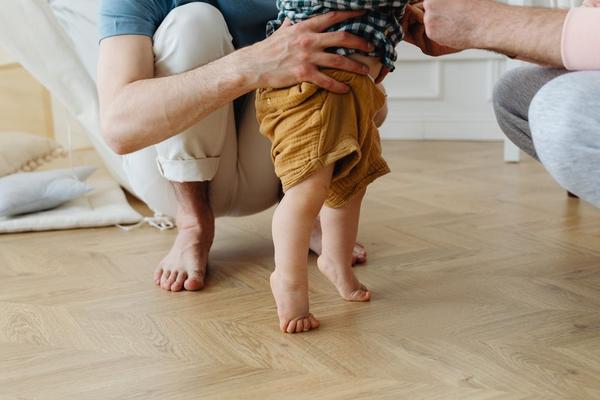
The first steps baby makes often look unlike adult walking: feet wide apart, arms lifted, knees bent and a quick drop to the floor. They may manage two steps one day and choose crawling the next. That does not mean they have gone backwards; crawling may remain their faster way to travel.
Growing steadier and more confident
After the independent walking milestone, practice helps children start, stop, turn and recover from wobbles. Their stance usually becomes less wide. Carrying a toy, bending to pick something up and navigating new surfaces bring fresh challenges. Walking alone is a beginning, not the finish line.
How to encourage walking without rushing it
Make everyday play the practice session. Choose a clear, level floor and stable furniture that cannot tip. Let your baby decide when to pull up, cruise or sit down rather than placing them upright before they are ready.
For example, if your child already cruises along the sofa, place a favourite soft toy just to one side on the cushion. Once this feels easy, position another secure piece of furniture close by, with an adult alongside, so they can explore moving between supports. Never create a gap they must cross or pull them forward to force a step.
You can sit a little way in front of a baby already standing confidently, open your arms and invite them towards you. Praise the attempt, including a decision to lower themselves and crawl. The aim is curiosity, not a daily step count.
If your baby is still working on earlier movements, guides to baby crawling milestones and pulling to stand can help you recognise progress before walking begins.
Make the practice space safe
Indoors, barefoot walking on a safe, non-slip surface lets developing feet feel the floor. Shoes are mainly for protection outside once walking is established; choose flexible, well-fitting footwear rather than stiff fashion shoes.
Secure furniture, protect sharp corners and remove trailing cords. Fit suitable stair gates and supervise closely near steps. A toddler gaining speed can reach a doorway long before they understand the danger.
Avoid relying on sit-in baby walkers to teach walking. The NHS warns that frequent use of walkers and bouncers can encourage tiptoe standing and may delay walking. A stable push-along toy can offer play opportunities for a child already cruising, but it is not necessary and requires close supervision, especially on slippery floors.
What if your baby is not walking yet?
A later start does not automatically indicate a problem. Children who bottom shuffle may walk later, and babies born prematurely may need assessment using their corrected age. Consider the overall pattern: how your child moves, bears weight, uses both sides of the body and gains new skills over time.
If your child is not walking independently by around 18 months, contact your health visitor or GP for advice rather than waiting indefinitely. Seek advice sooner if your baby is not trying to stand or bear weight, seems unusually stiff or floppy, consistently favours one side, appears to be in pain or loses a skill they previously had.
A professional may ask about your child’s movement history and observe standing and stepping. If needed, they can arrange further assessment or paediatric physiotherapy. Asking about a delayed walking baby is a sensible way to get individual guidance, not a reason to assume something serious is wrong.
Frequently asked questions
Is it normal for a 12-month-old not to walk?
Yes. Many 12-month-olds are still cruising, crawling or practising standing. Notice their broader movement progress, and speak with your health visitor if you are worried.
Does cruising mean my baby will walk soon?
Cruising is an encouraging step, but it cannot predict the exact date of first steps. Some children let go quickly; others prefer support for several months.
Should I hold my baby’s hands to help them walk?
Brief, gentle support can be part of play when your baby is ready to stand and step. Avoid pulling them along by raised arms or insisting on walking when they want to sit. Independent balance matters more than distance covered with adult help.
Why has my baby stopped taking steps after starting?
Occasional changes in confidence are common, especially after a tumble or when crawling is easier. If your child truly loses an established ability, or has pain or a new limp, seek medical advice promptly.
From first steps to finding their feet
Baby walking milestones are better understood as experiments than a race towards one date. The careful sideways cruise, the brave moment of letting go and the wobbly journey across the rug all count. Offer safe practice, celebrate individual progress and turn to your health visitor whenever something concerns you. As walking becomes steadier, simple toddler balance activities can make movement part of everyday play.